
Insight
Data Doesn't Drive Growth. Decisions Do.
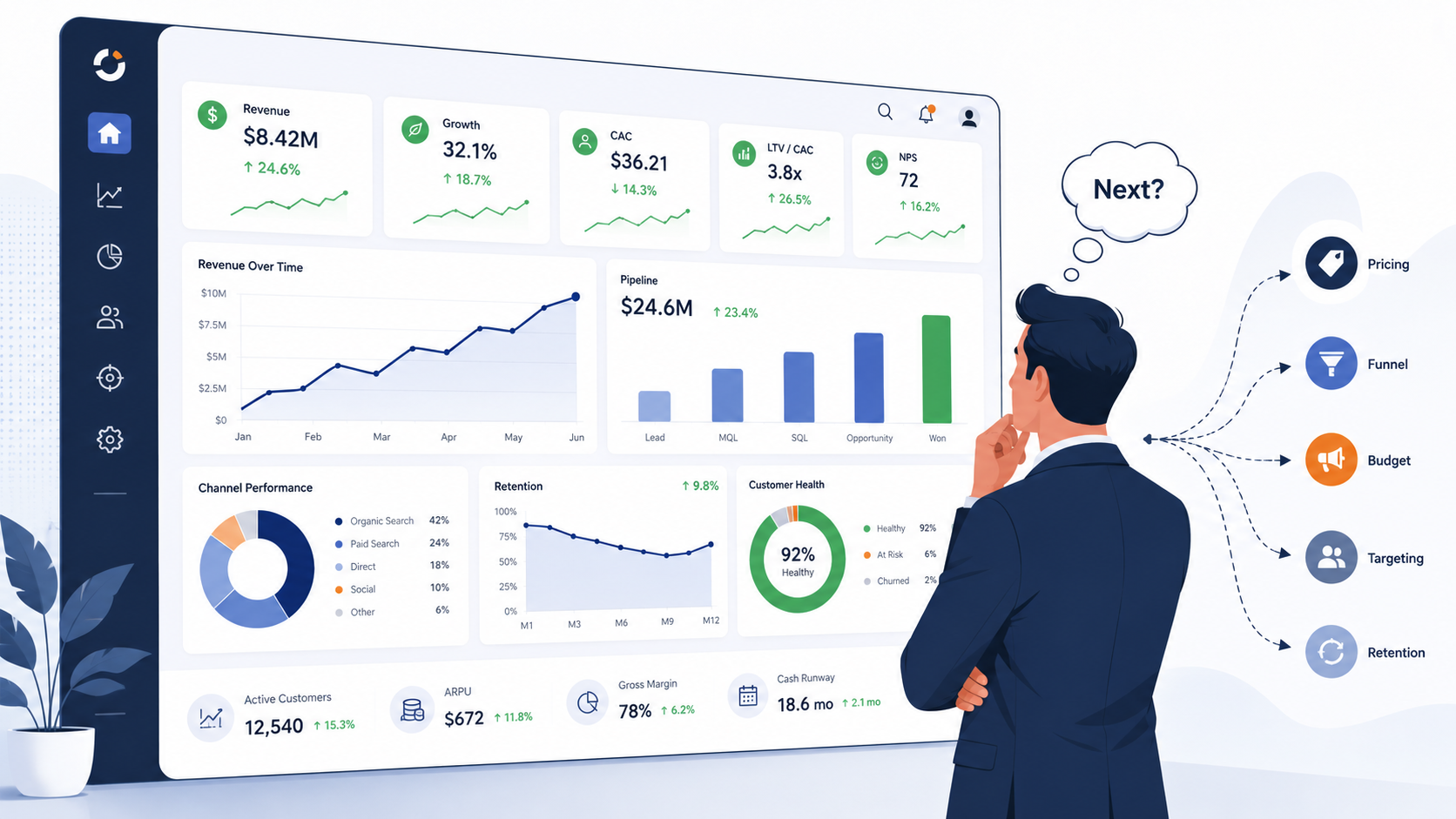
Most businesses have more data than ever. More dashboards, more reports, more tools. But when the hard growth questions arrive, the data rarely answers what to do next. The problem isn't a lack of data. It's a lack of decision clarity.
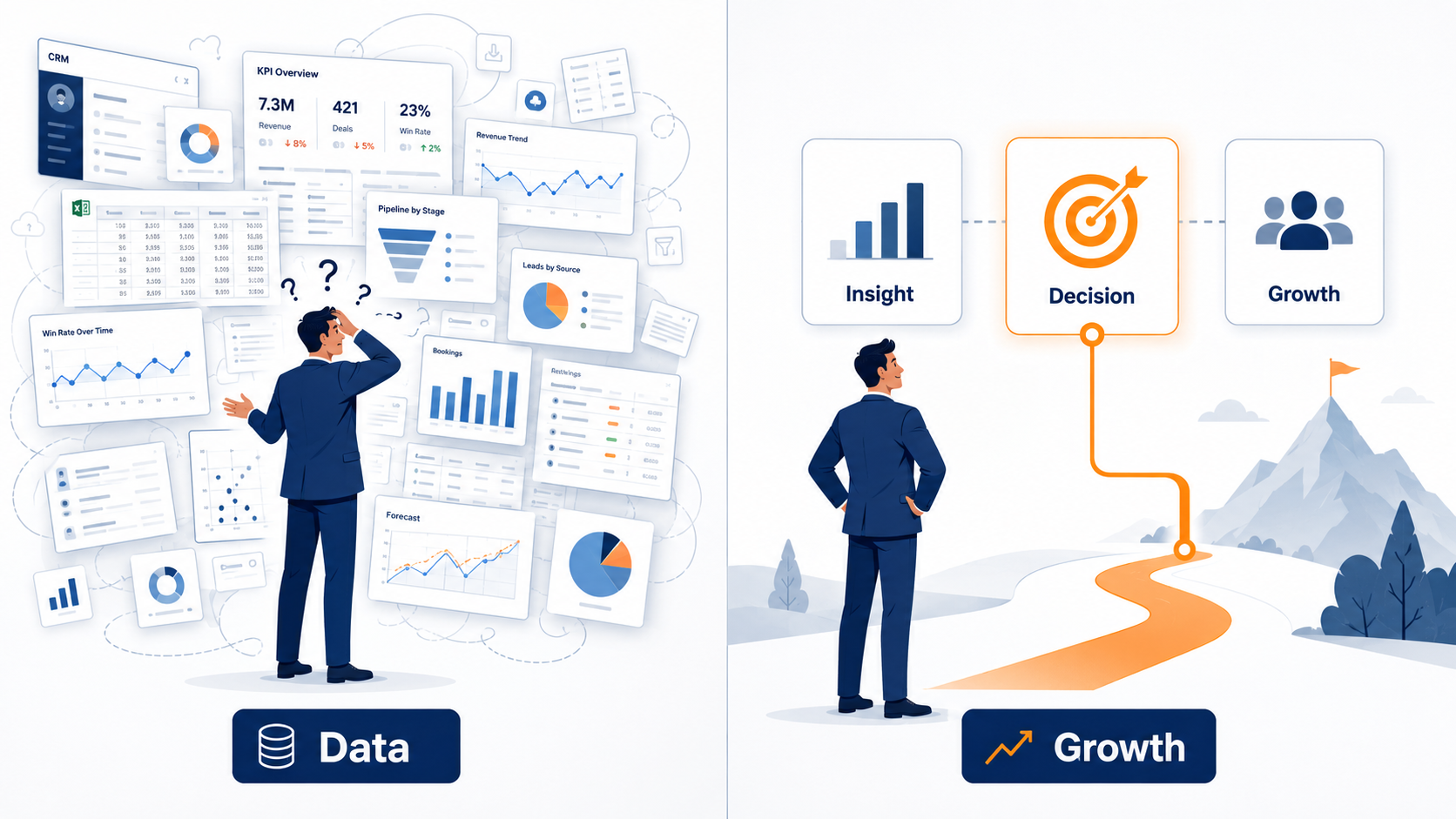 The gap between having data and knowing what to do next is where most revenue is lost.
 Here is what most growing businesses look like right now. They have a CRM, a marketing analytics platform, a revenue dashboard, campaign reports, website data, sales forecasts, and financial summaries. Some have all of this feeding into a BI tool. A few have a dedicated data analyst or a revenue operations team pulling it together every week.
And yet. When the leadership team sits down to answer the growth questions that actually matter, the room goes quiet.
Which channel should we scale? · Why is revenue flat despite more leads? · Where is the funnel leaking? · Which customer segment is worth pursuing? · What should we stop doing?
The data is there. But the answer isn't.
That is not a data problem. That is a decision problem. And it is far more common than most leaders want to admit.
# More Data Does Not Automatically Create Better Decisions
When revenue growth stalls, the instinct is usually to add more. More reporting. More metrics. Another dashboard. A new analytics tool. Another agency asking for access to the data.
The assumption is that somewhere in the extra visibility, the answer will appear.
It usually doesn't.
McKinsey research found that only 20% of organizations say they excel at decision-making. Deloitte found that fewer than 4 in 10 large-company executives placed their firms in the top two 'insight-driven' maturity categories. These are not small companies with limited budgets. These are businesses with data teams, enterprise software, and serious analytics investment.
The bottleneck is rarely data collection. According to Wavestone's 2024 Data and AI Leadership Survey, the biggest barrier to becoming data-driven is not technology — it is culture, people, process, and organizational alignment. The tools exist. The discipline to turn signals into decisions does not.
More data collected without a clearer decision process just creates more noise to manage.
# The Stack Most Teams Confuse
One of the core reasons growth decisions stay blurry is that leaders conflate five very different things. They treat them as the same layer when they are not.
Data is raw material. CRM records, campaign events, product usage logs, support tickets, invoices, churn events. It has no inherent value on its own.
Reporting organizes what happened. Dashboards, KPI scorecards, pipeline reports, monthly reviews. It answers: where do we stand?
Analytics helps explain patterns. Descriptive, predictive, and sometimes prescriptive techniques that look for causes, correlations, and likely futures.
Insight identifies what matters. It is the translation from 'pipeline is down' to 'pipeline is down specifically in mid-market accounts, driven by weaker first-meeting conversion since the ICP changed.'
Decision-making commits the business to what changes next. Someone names the action, owns the outcome, sets the timeline, and reviews the result.
Most teams stop somewhere between reporting and insight. They have visibility. They just don't have a decision.
Growth only happens when the organization reaches the decision layer — when someone says: this is what we are changing, I own it, and here is how we will know if it worked.
Here is what most growing businesses look like right now. They have a CRM, a marketing analytics platform, a revenue dashboard, campaign reports, website data, sales forecasts, and financial summaries. Some have all of this feeding into a BI tool. A few have a dedicated data analyst or a revenue operations team pulling it together every week.
And yet. When the leadership team sits down to answer the growth questions that actually matter, the room goes quiet.
Which channel should we scale? · Why is revenue flat despite more leads? · Where is the funnel leaking? · Which customer segment is worth pursuing? · What should we stop doing?
The data is there. But the answer isn't.
That is not a data problem. That is a decision problem. And it is far more common than most leaders want to admit.
# More Data Does Not Automatically Create Better Decisions
When revenue growth stalls, the instinct is usually to add more. More reporting. More metrics. Another dashboard. A new analytics tool. Another agency asking for access to the data.
The assumption is that somewhere in the extra visibility, the answer will appear.
It usually doesn't.
McKinsey research found that only 20% of organizations say they excel at decision-making. Deloitte found that fewer than 4 in 10 large-company executives placed their firms in the top two 'insight-driven' maturity categories. These are not small companies with limited budgets. These are businesses with data teams, enterprise software, and serious analytics investment.
The bottleneck is rarely data collection. According to Wavestone's 2024 Data and AI Leadership Survey, the biggest barrier to becoming data-driven is not technology — it is culture, people, process, and organizational alignment. The tools exist. The discipline to turn signals into decisions does not.
More data collected without a clearer decision process just creates more noise to manage.
# The Stack Most Teams Confuse
One of the core reasons growth decisions stay blurry is that leaders conflate five very different things. They treat them as the same layer when they are not.
Data is raw material. CRM records, campaign events, product usage logs, support tickets, invoices, churn events. It has no inherent value on its own.
Reporting organizes what happened. Dashboards, KPI scorecards, pipeline reports, monthly reviews. It answers: where do we stand?
Analytics helps explain patterns. Descriptive, predictive, and sometimes prescriptive techniques that look for causes, correlations, and likely futures.
Insight identifies what matters. It is the translation from 'pipeline is down' to 'pipeline is down specifically in mid-market accounts, driven by weaker first-meeting conversion since the ICP changed.'
Decision-making commits the business to what changes next. Someone names the action, owns the outcome, sets the timeline, and reviews the result.
Most teams stop somewhere between reporting and insight. They have visibility. They just don't have a decision.
Growth only happens when the organization reaches the decision layer — when someone says: this is what we are changing, I own it, and here is how we will know if it worked.
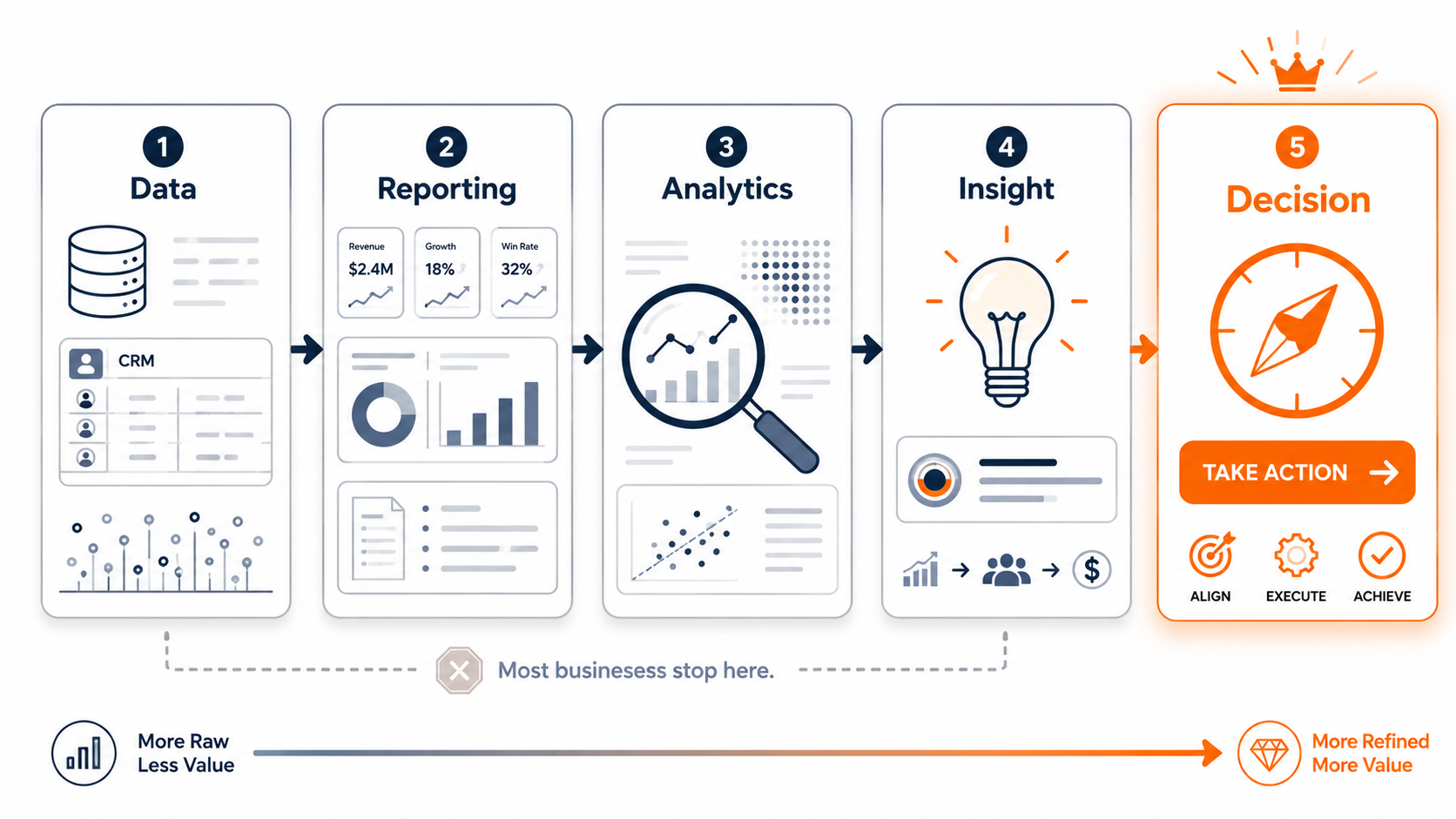 Data becomes valuable when it moves all the way from raw signal to owned decision.
# The Decision Gap
The decision gap is the space between what the numbers show and what the business should do next.
It shows up constantly in revenue conversations. The data is visible. The move is not.
CAC is rising. Should the team change targeting, the offer, the landing page, the sales follow-up, or the pricing structure?
Leads are up. Should the company scale the campaign — or question whether lead quality has quietly dropped?
Churn is rising. Is the problem onboarding, product fit, customer expectations, support quality, or pricing?
Revenue is flat. Is the issue traffic, conversion rate, deal size, retention, or margin erosion?
In each case, the numbers confirm that something changed. But they do not tell the team which lever to pull. That ambiguity is the decision gap. And until it closes, spending more on campaigns, tools, or headcount just amplifies the problem.
Data becomes valuable when it moves all the way from raw signal to owned decision.
# The Decision Gap
The decision gap is the space between what the numbers show and what the business should do next.
It shows up constantly in revenue conversations. The data is visible. The move is not.
CAC is rising. Should the team change targeting, the offer, the landing page, the sales follow-up, or the pricing structure?
Leads are up. Should the company scale the campaign — or question whether lead quality has quietly dropped?
Churn is rising. Is the problem onboarding, product fit, customer expectations, support quality, or pricing?
Revenue is flat. Is the issue traffic, conversion rate, deal size, retention, or margin erosion?
In each case, the numbers confirm that something changed. But they do not tell the team which lever to pull. That ambiguity is the decision gap. And until it closes, spending more on campaigns, tools, or headcount just amplifies the problem.
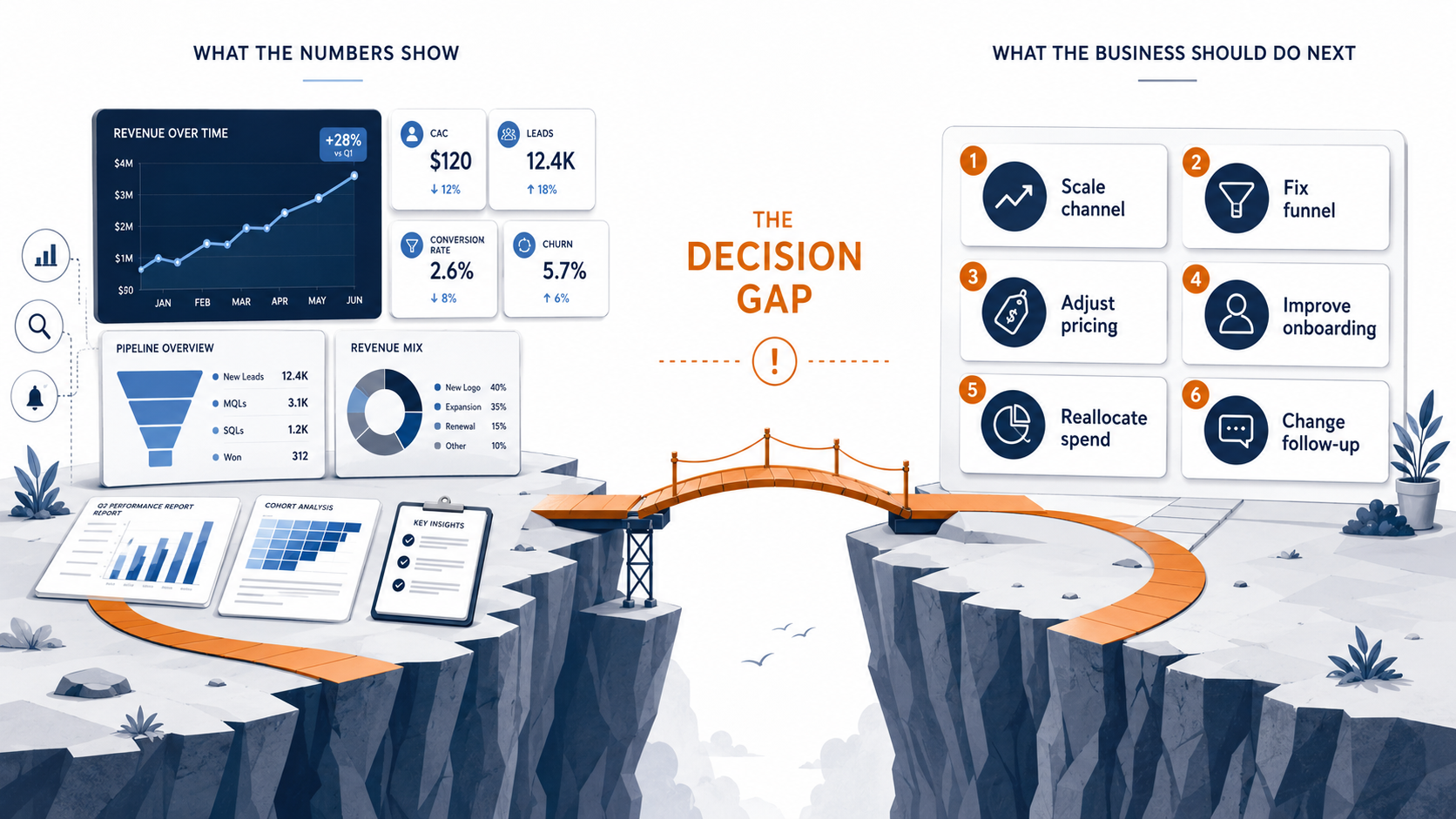 The decision gap appears when the business can see the numbers but cannot clearly choose the next move.
# Dashboards Can Create False Confidence
Dashboards are not the enemy. Every serious revenue team needs them. The problem is what teams assume a dashboard actually does.
A dashboard shows what changed. It does not reliably explain why. And it almost never tells the team what decision should change next.
McKinsey has written directly about this: traditional dashboards tend to overwhelm managers with too much information and too few actionable insights — the result is often analysis paralysis rather than sharper decisions. IBM makes the same point from a different angle: dashboards are built for snapshots and summaries, not for exploratory or decision-ready analysis.
A dashboard can make a business more observable without making it more decidable.
A green number on a dashboard can sit next to a serious, undetected revenue leak. A healthy-looking retention rate can mask accelerating churn in a key segment. A rising lead count can hide a collapse in lead quality. The dashboard looks fine. The business is drifting.
Dashboards measure status. Decisions move the business. Those are two different jobs.
The decision gap appears when the business can see the numbers but cannot clearly choose the next move.
# Dashboards Can Create False Confidence
Dashboards are not the enemy. Every serious revenue team needs them. The problem is what teams assume a dashboard actually does.
A dashboard shows what changed. It does not reliably explain why. And it almost never tells the team what decision should change next.
McKinsey has written directly about this: traditional dashboards tend to overwhelm managers with too much information and too few actionable insights — the result is often analysis paralysis rather than sharper decisions. IBM makes the same point from a different angle: dashboards are built for snapshots and summaries, not for exploratory or decision-ready analysis.
A dashboard can make a business more observable without making it more decidable.
A green number on a dashboard can sit next to a serious, undetected revenue leak. A healthy-looking retention rate can mask accelerating churn in a key segment. A rising lead count can hide a collapse in lead quality. The dashboard looks fine. The business is drifting.
Dashboards measure status. Decisions move the business. Those are two different jobs.
 A dashboard can look healthy while the next decision remains unclear.
# Why Revenue Teams Struggle to Act on Data
This is not about effort or intelligence. Revenue teams struggle to act because the environment they work in makes clear decisions genuinely hard. Here are the five patterns we see most often.
1. Too many metrics, no hierarchy
When everything is tracked, nothing is prioritized. McKinsey recommends no more than three to eight KPI-level metrics at any given management level. Most revenue teams are working with multiples of that. When every number feels equally important, teams end up debating the data instead of deciding what to do about it.
2. Fragmented systems and conflicting definitions
Marketing has its version of 'a lead.' Sales has a different one. Finance has a third. Oracle research found that 41% of business leaders cited lack of agreement on data as a top-three workplace decision challenge. When the definitions don't match, the conversation stalls at reconciling numbers rather than deciding what to do with them.
3. Symptoms are visible. Causes are not.
Most dashboards surface outcomes — revenue, churn, CAC, win rate. But outcomes are lagging indicators. By the time they appear, the underlying problem has been compounding for weeks or months. A metric that tells you the score but not why the score changed is useful for measurement. It is not useful for deciding what to change.
4. No clear decision owner
When a number moves, who owns the response? In many revenue teams, the answer is unclear. Marketing owns part of the funnel. Sales owns another part. Customer success owns retention. Finance owns the budget. When ownership is diffuse, the instinct is to call a meeting rather than make a call. Decisions that require a meeting to find an owner are already late.
5. Over-reliance on lagging indicators
Revenue, bookings, and churn tell you what already happened. They are essential for accountability. But if they are the only signals being monitored, the team is always reacting. Leading indicators — pipeline velocity, onboarding completion rates, time-to-close by segment, conversion at each funnel stage — give teams a chance to intervene before the outcome lands. Most teams track lagging. Very few build decision triggers around leading.
# What Decision-Ready Data Looks Like
The fix is not a new tool. It is a different standard for what a useful signal should do.
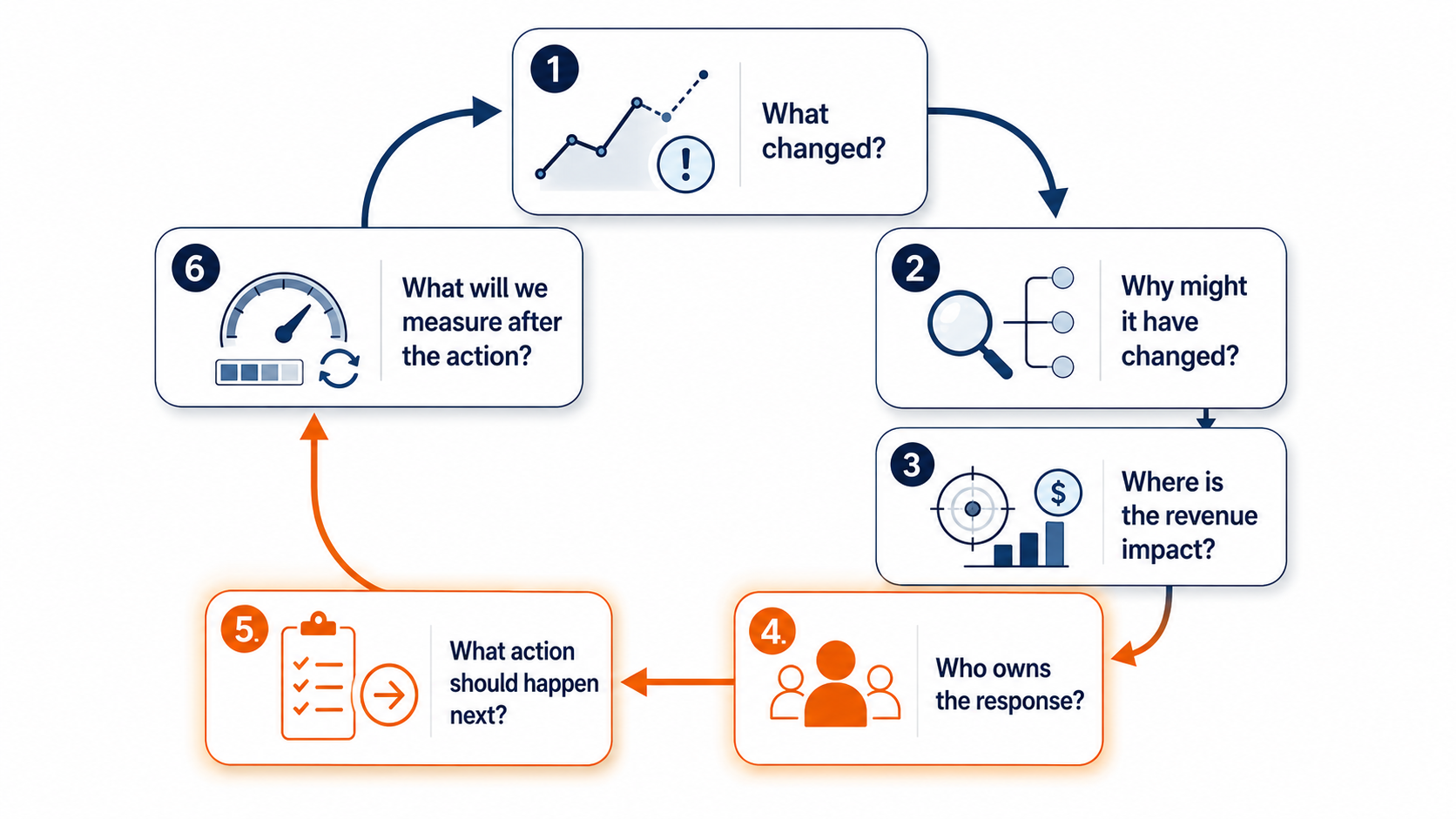
A revenue signal is only decision-ready if it can answer all six of these questions:
1. What changed? A specific metric moved beyond a defined threshold. Not a general trend — a concrete signal.
2. Why might it have changed? At least two or three credible explanations. Without this, the team spends the meeting guessing rather than deciding.
3. Where is the revenue impact? What is the likely cost or opportunity in actual revenue terms? This focuses urgency on the things that matter most.
4. Who owns the response? One named person or team is responsible for the next action. Not 'we all need to look at this.'
5. What action should happen next? A specific, testable response — not a vague directive to 'improve the funnel.'
6. What will we measure after the action? How will the team know, within a defined time window, whether the decision worked?
Most revenue data answers Question 1. Some answers Questions 1 and 2. Decision-ready data answers all six.
A dashboard can look healthy while the next decision remains unclear.
# Why Revenue Teams Struggle to Act on Data
This is not about effort or intelligence. Revenue teams struggle to act because the environment they work in makes clear decisions genuinely hard. Here are the five patterns we see most often.
1. Too many metrics, no hierarchy
When everything is tracked, nothing is prioritized. McKinsey recommends no more than three to eight KPI-level metrics at any given management level. Most revenue teams are working with multiples of that. When every number feels equally important, teams end up debating the data instead of deciding what to do about it.
2. Fragmented systems and conflicting definitions
Marketing has its version of 'a lead.' Sales has a different one. Finance has a third. Oracle research found that 41% of business leaders cited lack of agreement on data as a top-three workplace decision challenge. When the definitions don't match, the conversation stalls at reconciling numbers rather than deciding what to do with them.
3. Symptoms are visible. Causes are not.
Most dashboards surface outcomes — revenue, churn, CAC, win rate. But outcomes are lagging indicators. By the time they appear, the underlying problem has been compounding for weeks or months. A metric that tells you the score but not why the score changed is useful for measurement. It is not useful for deciding what to change.
4. No clear decision owner
When a number moves, who owns the response? In many revenue teams, the answer is unclear. Marketing owns part of the funnel. Sales owns another part. Customer success owns retention. Finance owns the budget. When ownership is diffuse, the instinct is to call a meeting rather than make a call. Decisions that require a meeting to find an owner are already late.
5. Over-reliance on lagging indicators
Revenue, bookings, and churn tell you what already happened. They are essential for accountability. But if they are the only signals being monitored, the team is always reacting. Leading indicators — pipeline velocity, onboarding completion rates, time-to-close by segment, conversion at each funnel stage — give teams a chance to intervene before the outcome lands. Most teams track lagging. Very few build decision triggers around leading.
# What Decision-Ready Data Looks Like
The fix is not a new tool. It is a different standard for what a useful signal should do.
A revenue signal is only decision-ready if it can answer all six of these questions:
1. What changed? A specific metric moved beyond a defined threshold. Not a general trend — a concrete signal.
2. Why might it have changed? At least two or three credible explanations. Without this, the team spends the meeting guessing rather than deciding.
3. Where is the revenue impact? What is the likely cost or opportunity in actual revenue terms? This focuses urgency on the things that matter most.
4. Who owns the response? One named person or team is responsible for the next action. Not 'we all need to look at this.'
5. What action should happen next? A specific, testable response — not a vague directive to 'improve the funnel.'
6. What will we measure after the action? How will the team know, within a defined time window, whether the decision worked?
Most revenue data answers Question 1. Some answers Questions 1 and 2. Decision-ready data answers all six.
 Decision-ready data connects signal, ownership, action, and follow-through.
# From Reporting-Heavy to Decision-Driven
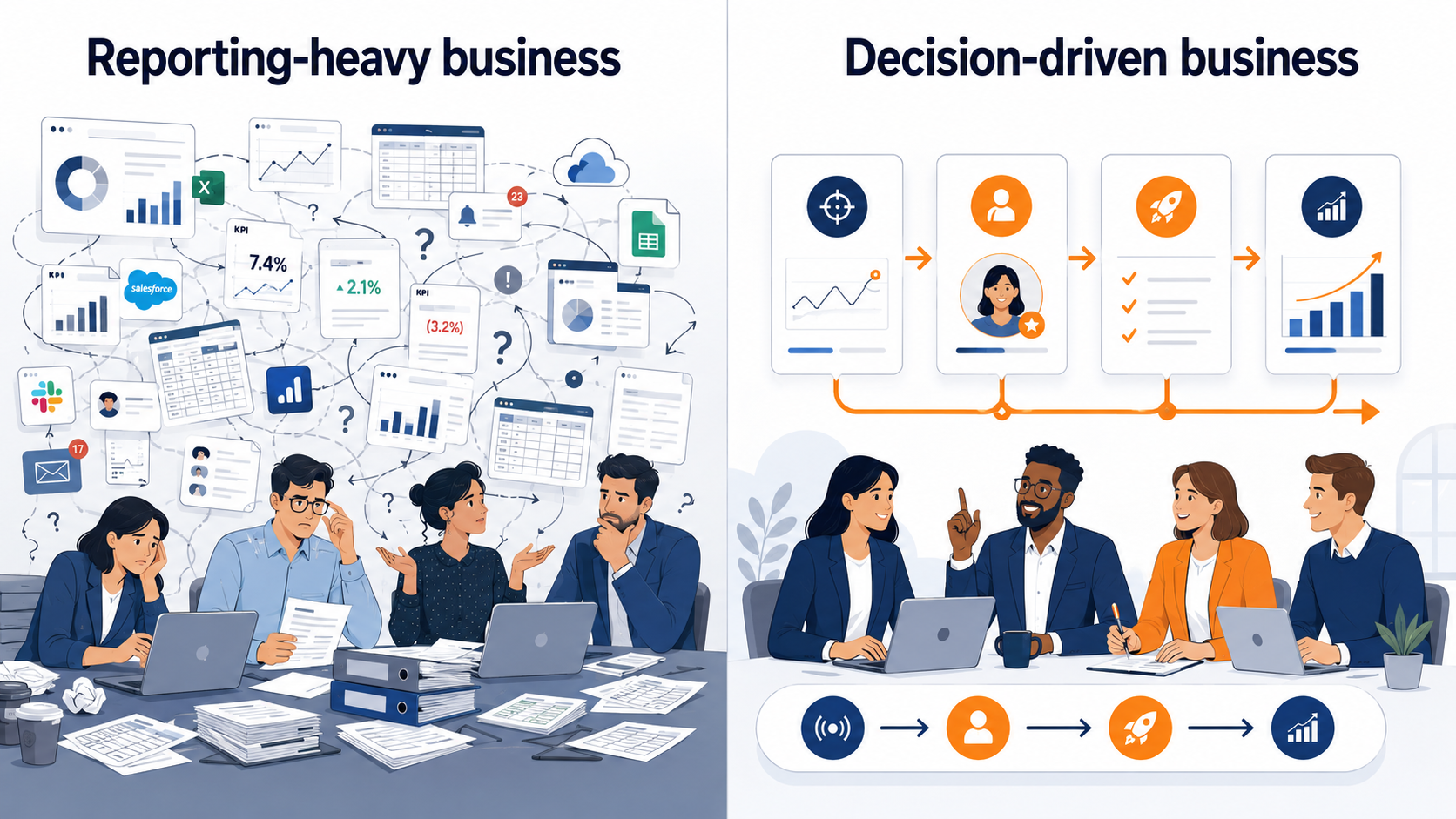
The difference between a reporting-heavy business and a decision-driven one is not how much data they have. It is how the organization uses it.
Reporting-heavy business
• Tracks many metrics across many dashboards
• Reviews reports frequently, debates numbers
• Ownership over what to do next is unclear
• Reacts to outcomes after they have already landed
• Mistakes visibility for progress
• Adds tools and reports when growth stalls
Decision-driven business
• Tracks fewer, sharper metrics with defined thresholds
• Connects every metric to a specific decision or action
• Every signal has a named owner and a response protocol
• Acts on leading indicators before outcomes land
• Measures the result of each decision, not just the outcome
• Asks 'what decision does this data support?' before building anything
Bain research found that organizations with top-quintile decision effectiveness achieve revenue and earnings growth more than three times greater than peers. The separation is not explained by market advantage or product quality alone. It is explained by how well the organization converts information into action.
Decision-ready data connects signal, ownership, action, and follow-through.
# From Reporting-Heavy to Decision-Driven
The difference between a reporting-heavy business and a decision-driven one is not how much data they have. It is how the organization uses it.
Reporting-heavy business
• Tracks many metrics across many dashboards
• Reviews reports frequently, debates numbers
• Ownership over what to do next is unclear
• Reacts to outcomes after they have already landed
• Mistakes visibility for progress
• Adds tools and reports when growth stalls
Decision-driven business
• Tracks fewer, sharper metrics with defined thresholds
• Connects every metric to a specific decision or action
• Every signal has a named owner and a response protocol
• Acts on leading indicators before outcomes land
• Measures the result of each decision, not just the outcome
• Asks 'what decision does this data support?' before building anything
Bain research found that organizations with top-quintile decision effectiveness achieve revenue and earnings growth more than three times greater than peers. The separation is not explained by market advantage or product quality alone. It is explained by how well the organization converts information into action.
 The goal is not fewer numbers. The goal is a clearer path from signal to action.
# The Mantis Predict Point of View
At Mantis Predict, we do not believe most businesses have a data shortage. They have a clarity shortage.
Revenue clarity is not about collecting more numbers. It is about knowing which signals matter, where revenue is leaking, and what decision should change next. Those three things together are what move a business forward. Separately, they are just expensive infrastructure.
The most expensive growth problems we see are rarely hidden by a lack of data. They are hidden by unclear interpretation, fragmented ownership, misaligned definitions, and decisions that never quite got made. The business can see the symptom. It just cannot commit to the treatment.
Before a business adds another campaign, another agency, another tool, or another sales hire, the most valuable question it can ask is this: do we actually know where our revenue is leaking, and do we have a clear decision about what to do next?
If the answer is no — or even 'we think so, maybe' — then more spend will not fix the problem. It will scale it.
# The Point
Data can inform growth.
But data does not choose a channel.
Data does not fix a funnel.
Data does not stop wasted spend.
Data does not decide what to change.
# People do.
Growth comes from turning the right signals into clear decisions, owned actions, and measured follow-through. That loop — signal to decision to action to result — is what separates businesses that scale efficiently from those that spend more and wonder why growth hasn't followed.
Before adding another dashboard, another report, another campaign, or another tool, ask a better question:
Do we need more data — or do we need more clarity?
# Ready to move from visibility to clarity?
If your business has the numbers but not the clarity, Mantis Predict can help you identify where revenue is leaking and what decision should change next.
The goal is not fewer numbers. The goal is a clearer path from signal to action.
# The Mantis Predict Point of View
At Mantis Predict, we do not believe most businesses have a data shortage. They have a clarity shortage.
Revenue clarity is not about collecting more numbers. It is about knowing which signals matter, where revenue is leaking, and what decision should change next. Those three things together are what move a business forward. Separately, they are just expensive infrastructure.
The most expensive growth problems we see are rarely hidden by a lack of data. They are hidden by unclear interpretation, fragmented ownership, misaligned definitions, and decisions that never quite got made. The business can see the symptom. It just cannot commit to the treatment.
Before a business adds another campaign, another agency, another tool, or another sales hire, the most valuable question it can ask is this: do we actually know where our revenue is leaking, and do we have a clear decision about what to do next?
If the answer is no — or even 'we think so, maybe' — then more spend will not fix the problem. It will scale it.
# The Point
Data can inform growth.
But data does not choose a channel.
Data does not fix a funnel.
Data does not stop wasted spend.
Data does not decide what to change.
# People do.
Growth comes from turning the right signals into clear decisions, owned actions, and measured follow-through. That loop — signal to decision to action to result — is what separates businesses that scale efficiently from those that spend more and wonder why growth hasn't followed.
Before adding another dashboard, another report, another campaign, or another tool, ask a better question:
Do we need more data — or do we need more clarity?
# Ready to move from visibility to clarity?
If your business has the numbers but not the clarity, Mantis Predict can help you identify where revenue is leaking and what decision should change next.